
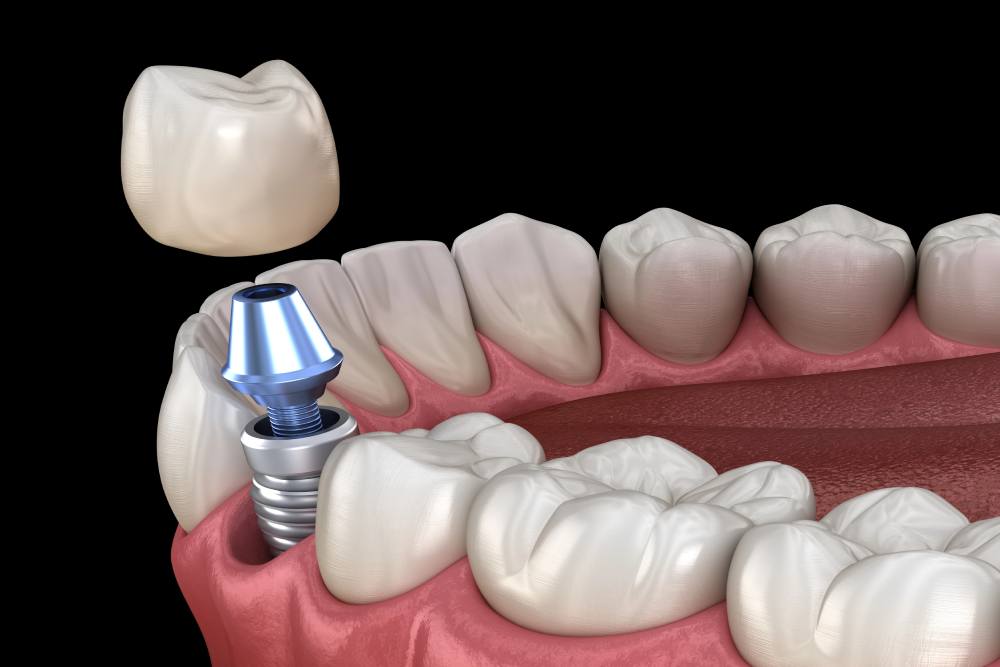
If you’re considering dental implants, one of the first questions that often comes up is “What do dental implants look like once they’re in place?” It’s a completely natural concern. After all, your smile is one of the first things people notice, and you want any dental solution to look and feel as natural as possible.
The reassuring news is that modern dental implants are designed to closely mimic real teeth. When done properly, they blend seamlessly into your smile – often so well that even you may forget which tooth is the implant.
In this article, we’ll walk through what dental implants look like at every stage, from the components beneath the surface to the final, natural-looking result you see in the mirror.
Understanding the Parts of a Dental Implant
The Implant Post (Hidden Below the Gumline)
The implant post is a small, screw-shaped component usually made from titanium. It is surgically placed into the jawbone and functions as an artificial root for the replacement tooth.
Once healing is complete, the post remains completely beneath the gums, providing a stable and secure foundation. Titanium is biocompatible, allowing it to fuse naturally with the jawbone through a process called osseointegration. This fusion gives the implant its strength, realistic feel, and long-lasting durability.
The Abutment (The Connector)
The abutment is a connector that attaches to the implant post and extends just above the gumline. It forms the base that holds the visible part of the tooth. While the abutment may be briefly visible during the treatment process, it becomes fully covered by the final crown. It does not interfere with the appearance of the smile.
The Crown (The Visible Tooth)
The crown is the portion of the implant that looks and functions like a natural tooth. Custom-crafted to match the surrounding teeth, it is carefully shaped, colored, and sized to blend seamlessly with the smile. Dentists focus on details such as enamel translucency, tooth contours, and bite alignment to create a result that feels natural and looks authentic.
How Similar Do Dental Implants and Natural Teeth Look?
Dental implants are designed to closely mimic real teeth. Unlike dentures or older tooth replacement methods, implants stand independently without relying on adjacent teeth for support.
From the outside, a dental implant looks just like a healthy, natural tooth. The color is matched to your existing teeth, the shape follows your natural smile line, and the crown reflects light in a way that mimics real enamel. There’s no visible metal, no bulky attachments, and no obvious signs of dental work.
Even the gum tissue around an implant is shaped carefully to create a natural-looking gumline. This attention to detail helps the implant blend in so well that most people can’t tell the difference.
What Do Dental Implants Look Like During Each Stage of Treatment?
After Tooth Removal (If Needed)
When a damaged or missing tooth must be addressed first, the gap may be temporarily visible. This phase can feel awkward for patients concerned about appearance.
In many cases, temporary solutions such as provisional crowns or partial dentures are placed to maintain the look of your smile. These temporary measures allow you to eat, speak, and smile comfortably while the area prepares for the implant, reducing any aesthetic concerns during the transition.
During Healing
As the implant post integrates with the jawbone beneath the gums, there is usually little to no visible change. The post is hidden, so your smile remains largely unaffected. For teeth in highly visible areas, temporary crowns or restorations can be used to preserve the appearance of your smile.
This stage preserves both aesthetics and function while the implant heals. The implant gradually bonds with the bone and brings long-term stability and strong support for the final restoration.
After Final Placement
When the permanent crown is attached, the transformation is complete. The implant blends seamlessly with your surrounding teeth, creating a natural, balanced, and confident smile.
The final restoration is carefully crafted to match the color, shape, and size of adjacent teeth, making the implant virtually indistinguishable from natural teeth. Patients often find that the new tooth feels completely integrated, both visually and functionally.
Why Dental Implants Don’t Look “Fake”
Dental implants avoid the artificial or “fake tooth” appearance because every component is custom-designed to suit the individual patient.
Factors such as facial structure, bite alignment, and the color and shape of surrounding teeth are all considered during planning and fabrication. Modern dental techniques and advanced materials allow dentists to replicate the subtle variations of real teeth, including enamel translucency and light reflection.
For patients who care about both functionality and appearance, dental implants provide one of the most natural-looking tooth replacement options available. Each implant is designed not only to restore the tooth’s role in eating and speaking but also to maintain the harmony and aesthetics of your smile for years to come.
What Materials Are Used to Create Natural-Looking Dental Implants?
The realistic appearance of dental implants largely comes from the high-quality materials used in their construction. Each component is selected to balance strength, durability, safety, and a natural look.
The implant post is typically made from medical-grade titanium, which has been used safely in dentistry and medicine for decades. While this part is never visible, its ability to bond with the jawbone is essential for long-term success and a natural feel.
The visible part of the implant, the crown, is typically crafted from porcelain or zirconia. These materials are chosen because they closely mimic natural tooth enamel. They reflect light in the same way as real teeth, resist stains, and can be precisely color-matched to surrounding teeth.
This careful matching makes sure that the implant blends seamlessly with your smile, without appearing brighter, duller, or out of place compared to your natural teeth.